The most part of researches of the profit market range of efficiency is construction on selection of financial performance in the financial reporting, a code of a type of activity NACE Rev.2 of the company and its activity on the Internet. [1]
Does this approach give real market range or only a part of it?
If there are strict rules for financial accounting (IFRS), the code of activity of the company is defined subjectively [2]. Mostly, statistics are served in the adjacent codes. Sometimes, the activity is changing, but the code remains old. More often, basic code of activity is shown in statistics doesn’t coincide with the way the company positions in the Internet, especially with real activity. If at the active, independent, Monofunctional Company with the good website the adjacent or old NACE Rev.2 code is specified, then the result of a benchmarking study will be distorted. If there are a lot of companies or their performance indicators differ, then found range cannot be market.
Is there alternative choice on NACE Rev.2?

Nowadays, difficult imagine the real, independent company without active promotion their goods and services on the Internet. Without SEO. Can the test of the activity to become an additional selection or completely replaced the choice on NACE Rev.2?
The modern systems analytics of the activity on the Internet (Alexa.com, Similarweb.com, Semrush.com, Google Analytic, Piwik) give us a wide range of data:
Alexa.com

- Popularity (statistics and dynamics) visits of the website of the studied company

- The market of certain goods and in which services the company is provided

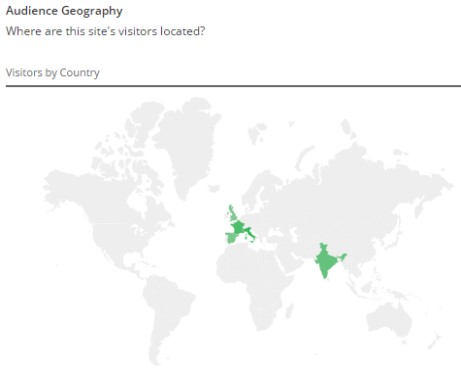
- Location (region) visitors of the site

- Information positioning of the company in information space (which keywords is advanced the company)

- Comparison of group sites (competitors) in certain information segment (search of product/service)

- Individual information about visitors of the site and etc [3].

There are different ”additive” approach in a benchmark study. [4] Also we can use SEO analytics such as ”additive” in TP reaserch.
How we can use it in researching of market range?
For example:
For final selection of the comparable companies:
- It is possible to determine is this site of the company is an active or its only site card;
For functional comparable company analysis:
- It is possible to determine whether the company carries out real marketing function;
For definition of a kind of activity:
- It is possible determine on which market this company is active (Most of all advances their goods/services);
For definition of comparability of the market of the selected companies:
- It is possible to determine on which geographic market the company is popular;
For corrections of indicators of the comparable companies:
- It is possible to determine what market share the company proceeding from popularity of this company in a certain information segment of the market borrows.
Of course, not on every site it is possible to get enough information and analytics of these services not always can be exhaustive. But similar information technologies develop every day. Transfer pricing is not exact science [4]. Thats why such modern analytics services can find wide using in definition of market information.
Of course after experienced exploitation. 😉
_______________________________________________________________
[1] Global database, Orbis, Bureau Van DjiK, www.bvdinfo.com
[2] Regulation (EC) No 1893/2006 of the European Parliament and of the Council of 20 December 2006 establishing the statistical classification of economic activities NACE Revision 2 and amending Council Regulation (EEC) No 3037/90 as well as certain EC Regulations on specific statistical domains Text with EEA relevance
[3] Alexa’s digital marketing tools, http://www.alexa.com
[4] Rahul Bagaria, Identification of TP comparables for regulated industries
[5] OECD Transfer Pricing Guidelines for Multinational Enterprises and Tax Administrations 2010

 Oleksii Sorokin Blog
Leave a comment