The plan of BEPS went into the active phase; large multinational companies are in a great danger of reporting to the tax administrations, banks are refusing to work with off-shores and beneficiaries from non-trustworthy jurisdictions. Whereas, quantity of multinational companies all over the world just rising up. Even small and medium-sized international business is placed in conditions when it’s necessary to determine their taxes under the rules of transfer pricing. The question is for how existing methodology is ready for this?
Can the range of profitability built by only 3 companies in the sample are truly market-oriented and serve as a benchmark for hundreds of large multinational corporations, thousands of medium-sized, and small international companies? Due to what can you increase the objectivity of market research? How can the logarithmic nature of profits be used to define “safe harbors”? How can tax administrations help to improve the quality of activity verification for market research? This and other approaches in research for the purpose of transfer pricing will be discussed in this article.
“Friendship is friendship, and economy is in disarray”
New messengers, social media, cloud projects became another driver of growth for international communication and for economic in whole. First of all, at the expense of the possibility of uniting people outside is the territorial sign. Trading Internet sites and payment systems are increasingly becoming multinational and many large, once regional exchanges, already position themselves as international. Not only large, but medium-sized and small businesses are looking for possibilities to work on external markets, rising up and quantity of multinational companies (having representative offices or subsidiaries in different countries). We can say, that government borders it’s just question of the time. According to forecasts from some experts in the nearest future machine translations can go to qualitatively new level [1]. Another breakthrough in the automation of translations can be a turning point in overcoming the language barrier and humanity will again have the opportunity to continue building the “Tower of Babel”.
Other side, economic and political situation in most of developed countries tends to reverse economic globalization. So-called “conservative counterrevolution.”[2] Many people and target countries are not ready to give the power supranational structures and they’re not ready to join with less developed countries. Too high probability of not equivalent exchange as a result of merger, high probability of power loss due to the unpreparedness of the society to systems of this level. Therefore, the coming to power of “nationalist parties”, “withdrawals from unions” and “fences from migrants” will be popular in the coming years. There are two contradictory tendencies: unification and globalization in business, and “nationalization” at the state level, as a consequence, a high probability of growing conflicts between these spheres of life. In what way can this be expressed? For example, in the increase of disputes around the distribution of income (tax deductions). This can be like a dispute between business and state tax administrations, business and business, or between tax administrations of different states.
Besides, banks in many jurisdictions that promote offshore activities risk falling into the “sanctions lists”, beneficiaries from less developed jurisdictions find it increasingly difficult to open accounts for their companies in more developed jurisdictions. [3][4]BEPS is working.
What can help avoid future conflicts? – Sometimes, to be really “united”, you should become real “independent”. Why? To fairly assess the contribution of one party and the contribution of the other, it is fair to divide revenues, correctly calculate their profits, to understand their benefits and priorities from different associations. Thus, those state and interstate associations in which clear and understandable rules of distribution of incomes and profits for multinational companies will work together will have more benefits to the rest.
Best the enemy of the good
One of the main reasons why most countries in the world at the legislative level have introduced the rules of transfer pricing is the need for the state to receive tax payments in accordance with what actually the group enterprise should profit in each individual country of presence. If a group company receives from a transaction with another group company a profit that is different from that of independent companies on the market in similar transactions, taxes must be paid on the basis of the market price level or profitability.
Where does this market range come from?
There are 5 basic methods for determining the market price or profitability (the definition of compliance with the principle of “outstretched hands”) for transactions between related enterprises (comparative uncontrolled price method, resale method, cost plus method, net profit method, and profit distribution method).
Since there are very few databases with transactions and prices in them, and databases with profitability data of individual transactions in the world are not yet available in principle, methods based on comparing profits in transactions of multinational companies with the profit of unrelated companies are widely used.
The financial data of unrelated enterprises are contained in many databases, the most complete, and popular and at the moment the best is the database of the Van Dyke Bureau Orbis or its parts Amadeus.[5] It contains data from millions of companies around the world.
To determine the market range of profitability, the TP specialist identifies companies whose activities are comparable to transactions for which the range is determined by taking the following steps:
- Selects a comparable region (country or several countries)
- Chooses a comparable type of enterprise activity according to the NACE code, and of the millions of companies there are already thousands here (depending on the activity and the region)
- Then companies that belong to other companies or which have subsidiaries (the percentage of deviation in ownership ranges from 50% -20%),
- Rejects are not comparable in revenue companies, as well as unprofitable.
As a result of such steps, there remain from a few dozen to several hundred companies, for which there is one question – are these companies really engaged in the activities indicated in the statistics as their basis NACE?
- To this question, the TP specialist searches for an answer on the Internet and, as a rule, finds something.
On the one hand, the range found by such rules is better than any other. But is there an alternative? Certainly, through an increase in the number of comparable companies in the sample.
“The worst money” is squeezed out of the turnover “the best money”
For trying to see alternatives to current approaches to market research, let’s try to look at the situation as a whole. The state is interested in receiving tax payments from transactions in accordance with the profit on which the enterprise should claim from a transaction conducted on market terms. The profit of the enterprise depends on various factors in which the labor used, the resources involved, the invested capital, the level of business environment favorableness. All these factors, in turn, depend to a greater or lesser extent on state funding, from the provision of a law-enforcement and legal system, from the protection of property rights, from the system of health, education, and the pension system. The more tax revenues, the better the financing of factors that ensure the further profit of enterprises. As a rule, in all economically developed and affluent countries, the index of “ease of doing business” according to the annual assessment of DOING BUSINESS is higher than in developing countries and in low-income countries, and as a rule, low level of tax deductions [6]. The functions performed by the enterprise and the profits it receives are interrelated with the functions performed by the state and the tax revenues received by it. The stronger this relationship, the higher the efficiency of business and the economy of the state as a whole.
On the one hand, it is not fair if one entity in one state will be led to factors that are actually related to the “merits” of another enterprise in another state. In this case, it turns out that taxpayers of one country will finance another state, and in return they will not receive anything.
On the other hand, in the theory of profit generation, there are a huge number of factors that affect the profit of an enterprise and determine the degree of influence of a particular factor to be a difficult task, even for the enterprise itself, with a full range of information [7].
The commercial activity of a modern enterprise is a definite function (some kind of economic activity) in relation to certain factors of production (land, labor, capital, entrepreneurial abilities, and information) [8].
In 1.51, D.1.2. OECD Transfer Pricing Guidelines proceeds from the premise that “in transactions between two independent entities, compensation will usually reflect the functions that each enterprise performs (taking into account the assets used and the perceived risks).”[9]
In this case, the term “compensation” is not specified, whether there is a “revenue” or “net profit” of the enterprise. So, the income? Or profit? After all, there are factors that can affect income, but do not affect profit. Conversely, there are factors that affect profit, but do not affect income.
Factors that affect the commercial activities of an enterprise can be conditionally divided into five categories (Fig. 1):
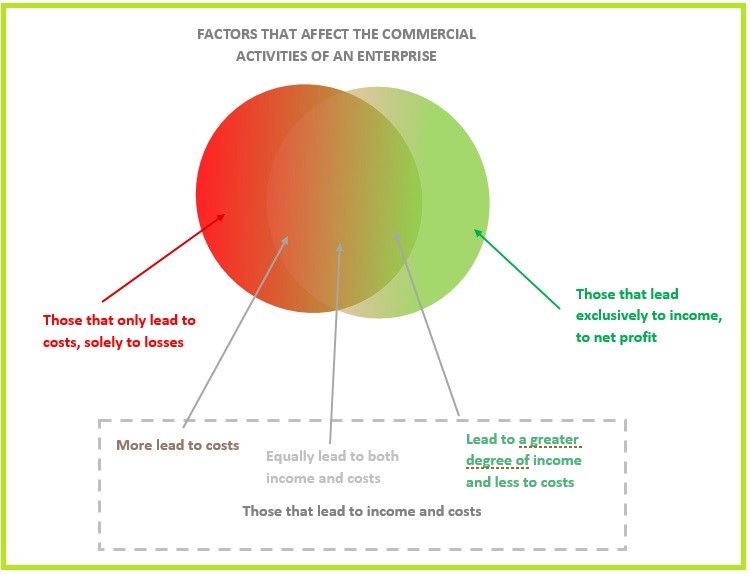
- Those that lead exclusively to income, to net profit (brand of the country, absolute exclusivity in the market)
- Those that only lead to costs, solely to losses (fines, force majeure, activities that have fallen under the embargo)
- Those that lead to income and costs, the latter, in turn, are also divided into three categories:
- Lead to a greater degree of income and less to costs (lead to profit),
- Equally lead to both income and costs,
- More lead to costs (lead to losses).
In the conditions of market equilibrium, the entire income of the firm is distributed among various factors of production in accordance with their marginal product [10][11].
If capital is a fixed factor and labor is variable, the firm can increase production by using more labor. There are many different factors that somehow can lead to a breakdown of competitive equilibrium and the emergence of profits from the enterprise.
From the variants of their categorization is presented below (Fig. 2),
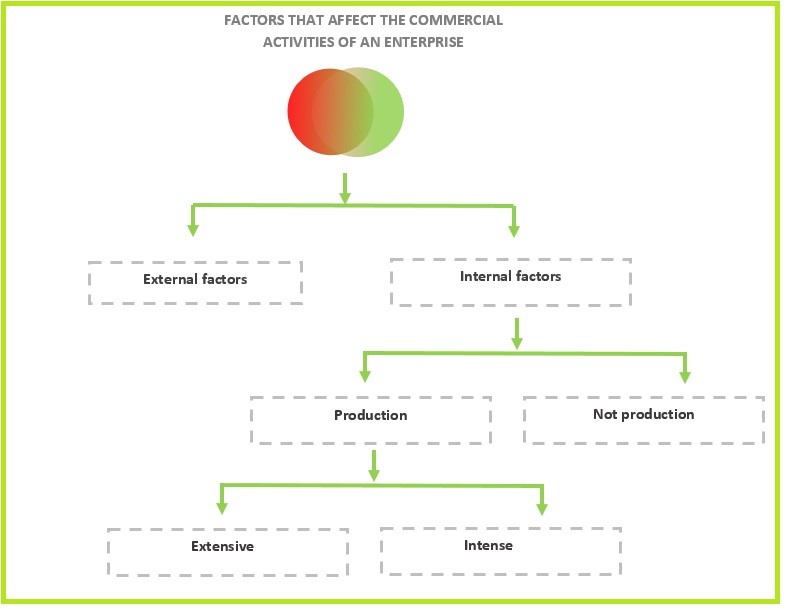
- External
- Internal,
- Not production
- Production,
- Extensive
- Intense.
But, the production factors (quantitative) lead to a greater degree of income, while the level of profitability affects the qualitatively performed functions (type of activity and level of professionalism).
How much use of quantitative restrictions (comparability by extensive factors of influence on profit) during the research is justified if for the application of the method based on the indicator of profit only the indicator of profitability is used, and not the size of profit?
First, quantitative or extensive factors (production factors), as a rule, is an independent tax base for the enterprise for other types of taxes:
- The income of employees will be taxed by the Personal Income Tax. Typically, this same work is the basis for social taxes (pension fund, insurance and other contributions).
- Land, real estate, vehicles, are also a separate tax base (Rent, land tax, property tax, transport tax);
- Transformation, converting of raw materials, goods, works, and services, forming or increasing the value in most countries are subject to Value Added Tax (VAT).
Secondly, according to the law of diminishing marginal productivity, the consistent increase in the variable resource with the invariability of the others leads to a diminishing return of this factor, i.e., to a decrease in the marginal product or the marginal productivity of labor. For example, if the recruitment of workers continues all the time, then in the end, they will interfere with each other (marginal productivity will become negative), and the output will decrease [12].
Each factor that leads to the profit of the enterprise, at a certain stage contributes to profit, and after a certain value, its impact is reduced. The moment from which the factor ceases to make a profit can also vary depending on other factors.
Thus, when we talk about profit and factors that have influenced it, we talk about some combination of factors and come to the quality of the organization of economic activity, the type of economic activity and the market situation (to intense and external factors).
As already mentioned above, the economic and comparative analysis of transactions of multinational enterprises is ultimately aimed at ensuring that the amount of tax deductions for each individual enterprise of the group corresponds to the functions performed by the enterprise in each individual state. In this case, the tax deductions of each enterprise will be maximally related to the functions performed by the state. But since the tax base is profit, not income, for such compliance it is necessary to determine the profit potential of a multifunctional enterprise by comparing it with an independent enterprise that conducts similar activities.
What will happen if, instead of the factors influencing the profit, to determine the profit-making potential, factors will be taken as a basis that equally affect revenues and expenditures (i.e. factors that do not actually lead to profit)?
Factors that affect profit are more complex factors than factors that affect income. Moreover, factors that affect income are much more quantified. Equating the factors, the degree of influence on the profit of which is higher, with factors whose degree of influence is less high, will lead to distortions in the calculation of tax payments. To some extent, this phenomenon is symmetric to another economic law: “Less valuable from the point of view of the currency market is displaced from the circulation more valuable in terms of the currency market, if they have the same currency denomination.”[13].
In this case, most likely the tax deductions of the multinational enterprise will be understated or overstated in general, or underestimated / overstated relative to individual states. The state will not receive tax payments for diligence for the benefit of business or business will bear unreasonable losses, which in the long term is also not profitable for the state, which counts on further prosperity of such business on its territory.
“There is safety in numbers”
The basic approach to building a market range is an approach based on individual values of companies in the final sample (construction of the interquartile range). It considers the profitability indicators of enterprises as a combination of the results of individual, unique companies, independent “players” in the market. There are many factors that affect the profit of an enterprise. (Fig. 2).
Conditionally they can be divided into external factors (level of demand, competition) and internal factors (production, non-productive). In the OECD Transfer Pricing Guidelines, these factors are repeatedly referred to as factors of comparability, internal are considered as functions (taking into account assets used and risks incurred), and external as economic conditions of activity. (Fig. 3).
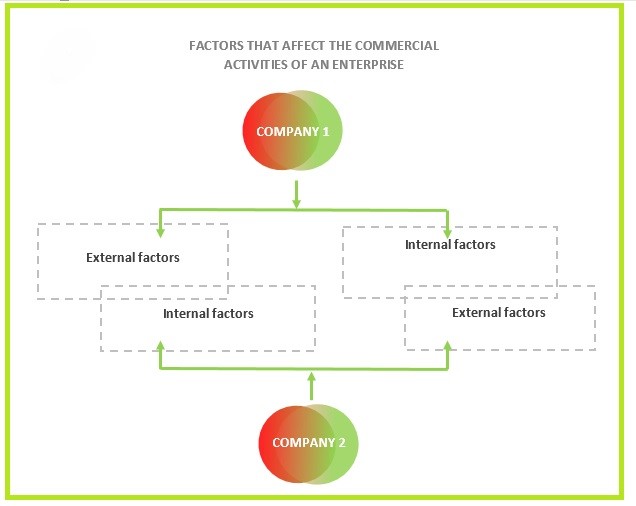
But when we talk about the “market” of certain goods or services, we can’t ignore such a factor as “competition.” In a competitive environment, the internal factors of influence on the profit of one enterprise on the market are external factors of influence on profit for another enterprise in the same market. Thus, the functions, assets, risks of one comparable enterprise are economic conditions for another comparable enterprise and conversely. In such a situation, considering indicators of comparable companies will be a more “market” approach than in calculating the performance of these companies as separate values. Let’s consider a small example. Enterprise A, B, C, D, E fell into the final sample of the study of the market range of profitability for activity X (Fig. 4). 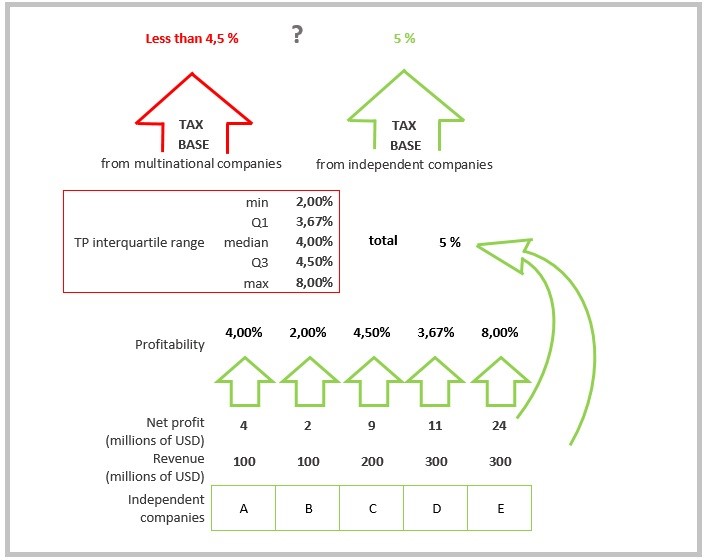 Enterprise E has a profitability index slightly higher than the rest due to, for example, the use of certain new technologies (exponential factor), but also this company has the largest revenue and profit due to, for example, additional investments in this company as the most promising. The interquantile range of the market level of profitability built on the basis of the performance of five companies will be from 3,67% to 4,50%. At the same time, the real (aggregate) level of profitability of these five companies is 5%. Accordingly, the tax base and the amount of profit tax paid to the budget in the interquartile calculation, in this example, will be lower than that paid by comparable companies operating under market laws. It is quite possible and the reverse situation, when because of the interquartile range the enterprise will have a larger profit margin and will pay more tax on profits to the budget than independent companies on the market. To do this, consider the following example with the same enterprises (Fig. 5).
Next year, enterprises A, B, C decides to catch up and overtake the company E. To do this, they undertake a number of upgrades, use the newest technologies in advertising (enhance the exponential factor).
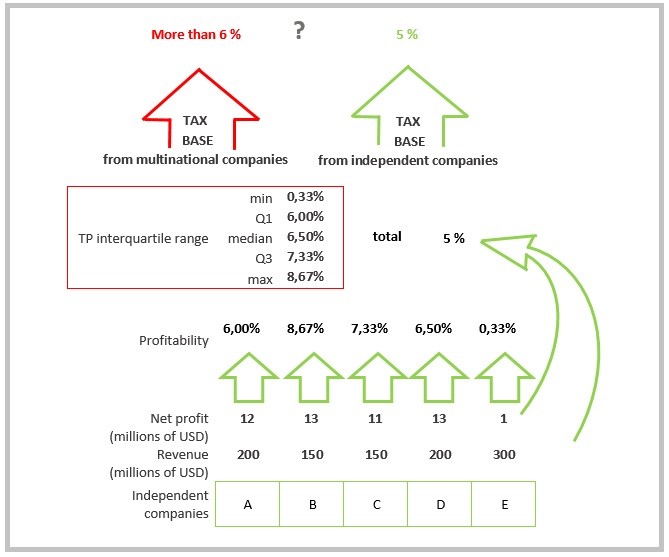
If the volume of the market (demand) is unchanged, a part of the company’s revenue E becomes the revenue of enterprises A, B, and C. If the costs of enterprise E are unchanged, its profitability decreases. The interquantile range in this case is from 7,33% to 6%, and the actual market range has not really changed and is still the same 5%. The first disadvantage of the “aggregate” approach is the inconvenience of applying just one value. Planned indicators very often differ from actual ones. On the transactions between related persons, market factors, such as logistics and sales costs, still influence the transactions. To be able to cover a part of the “unpredictability” it will be much easier if the market level of profitability is still in the form of a range. Such a problem can be solved by assuming, for example, the market% +/- range in bp. The next problem of the “cumulative” approach is the inadequacy of the values in the sample. For example, if 70% of companies operating on the market are excluded from the sample due to “insufficient information” and “availability of other activities”, the range can be “shifted” towards more profitable companies or, on the contrary, less profitable. It should be noted that this problematic is present in the interquartile approach to constructing the range. About how to increase the number of companies in the sample will be discussed next.
“Search for a black cat in a black room”
Even after the increase in companies in the final sample due to the reduction of restrictions on financial indicators and the reduction of bondage thresholds, a very large percentage of companies are excluded due to insufficient information on the actual activities of companies. In addition, the rejection or inclusion of companies on the basis of verification of activities on the Internet has some other disadvantages.
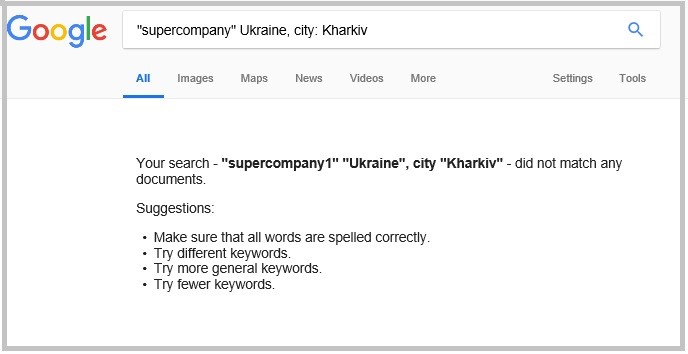
But what can qualitatively change the approach to checking activity?
Approach the information about the company to the actual operations? – Only the contractual documentation, invoices, payment documents of the enterprise contain information about the type of activity in which the income was received. Who has access to such information? Auditors and tax administrations on a regular basis check the payers in their jurisdiction these documents. Unfortunately, a full audit can’t afford all the enterprises, but the tax audit concerns everyone. As part of the tax audit, inspectors look at the contractual documentation, invoices, acts carry out a detailed analysis of the data for the reporting period. The creation of additional obligations for tax audit to confirm the main activity of the enterprise, in which income earned, will not require significant effort, but can significantly improve the quality and reliability of information about the actual activity of comparable companies for transfer pricing purposes. The note on the conformity of the declared type of activity to the actual can be published by the tax authority or transferred to the statistical body, transferred to other tax administrations within the framework of the agreement on automatic information exchange. An even more qualitative step can be a conditional percentage split of revenue within the main and auxiliary NACE codes, but for this it is necessary to make changes to the current requirements of the financial accounting and reporting standards. All joint-stock and individual large companies form and publish such statistics, but for a full analysis, statistics should be maintained at the level of financial reporting and for each company. Such a step will require the approval of the supreme board of IFRS [14]. But with the kind of activity in which profit is already made more difficult, this task will require access to accounting and management systems, which, in fact, will be a serious threat to confidentiality for businesses operating on market conditions. In addition, this task will be a serious task for analysis. Alternatively, in the event that the state is able and necessary to receive such information, the state will be able to buy such information from the enterprises after the information is no longer relevant to the market, but will be relevant for analysis or verification purposes.
The main question
By increasing the number of companies in the sample by checking activity, regardless of approaches to calculating the market range (cumulatively or by quartiles), the question of how many companies should remain in the final sample remains open. How many values (companies) should constitute a market range? Are there enough 3 companies in the sample? 5, 8, 10 or 20 companies? Is it possible to answer this question without determining the capacity of a particular market, the number of participants and the share of each participant in the market?
Below, are a few samples where the values of revenues, profits, assets and the number of employees and the profitability of companies in certain market segments (statistical (middle, large, very large companies)), without checking the activity on the Internet) are related to the number of these companies (sorted by increasing values).
Consider the main branches of sales and services (the production and extraction have similar trends) .
EXHIBIT 1
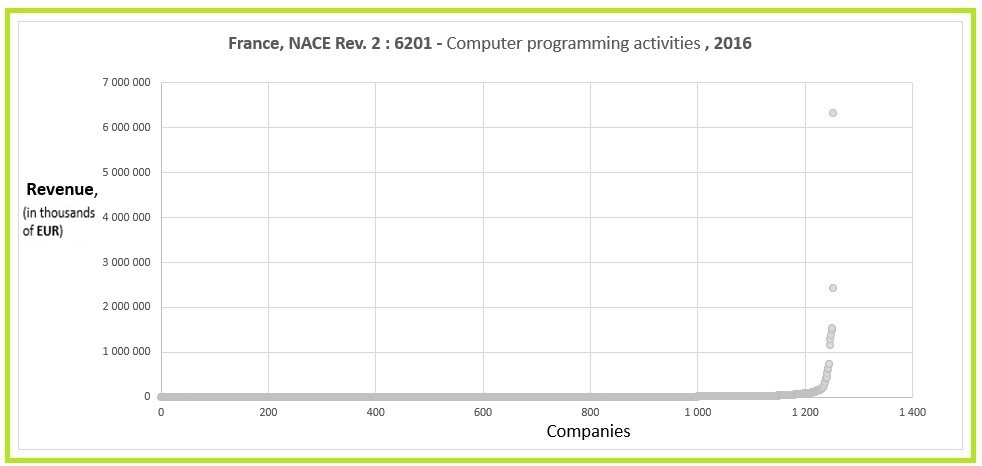
EXHIBIT 2
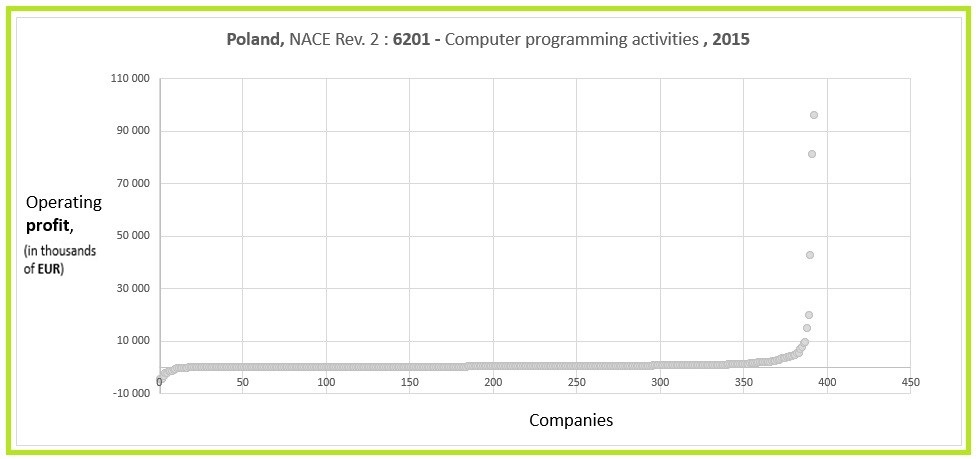
EXHIBIT 3
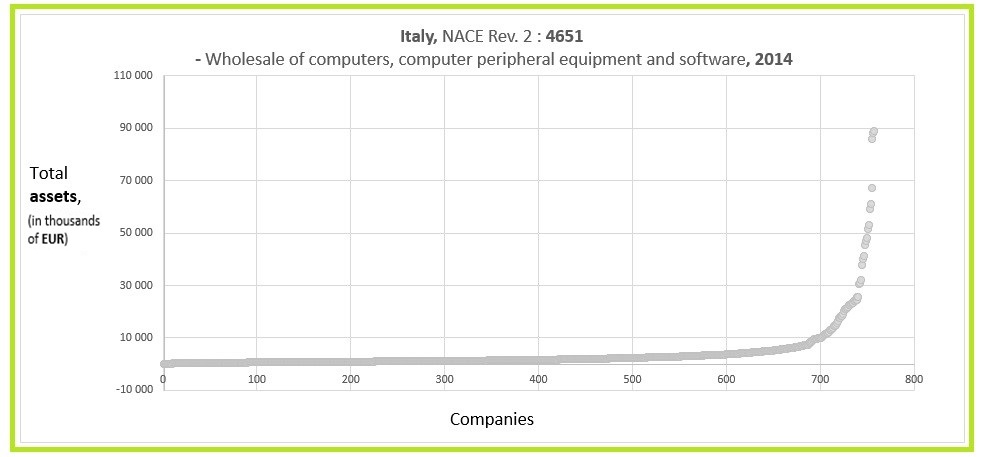
EXHIBIT 4
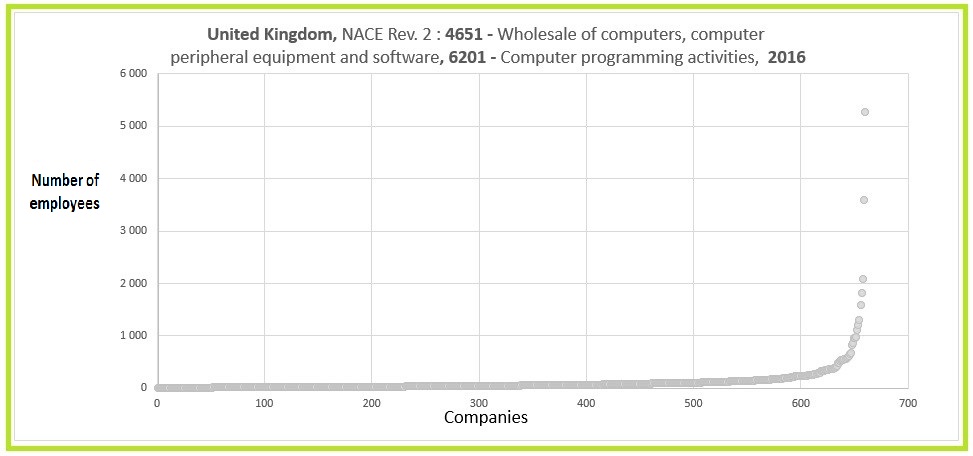
EXHIBIT 5 (+ small companies)
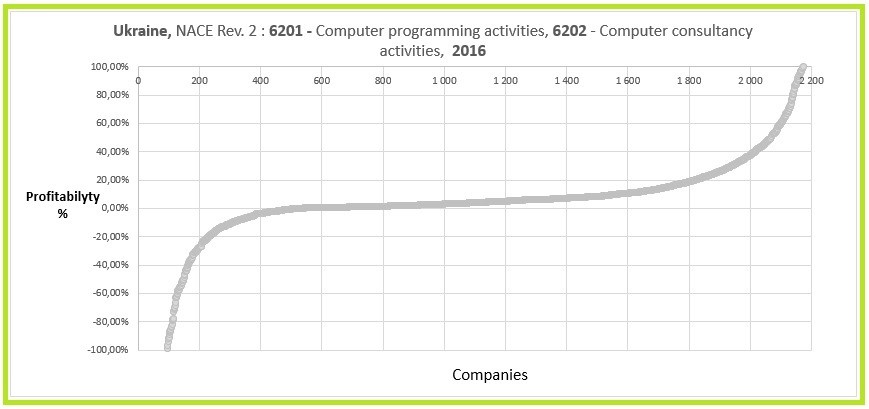
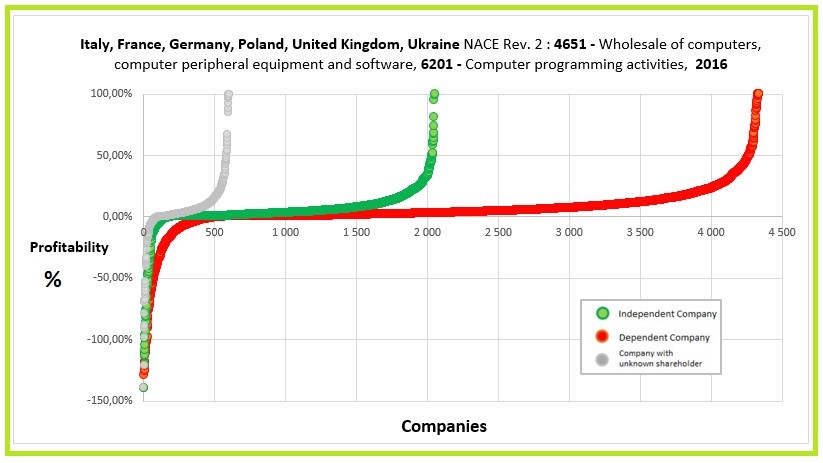
Regardless of the type of activity, the country and the period, the ratio of indicators represents certain curves that correlate with the mathematical function. In order to understand with which function the indicators most correlate, it is necessary to approximate the values in the sample. Most closely, these curves correlate with the exponential function:
у = ах Where Y is a certain indicator (revenue, assets, employees, profit or profitability)
Is “a” the minimum value or is it a separate indicator? What is X and how envy of quantity? These are separate questions. Most likely this is a separate law of perfect competition. The more income, the fewer companies (the more a company has money, the less its competitors). In this case, the exponential function correlates with the “competitive position curve”.
In addition, in order to exclude (check) the influence of the “dependence” factor, consider the following activity dividing the indicators of “independent”, “dependent” companies and companies with “an unknown share of ownership”.
EXHIBIT 6
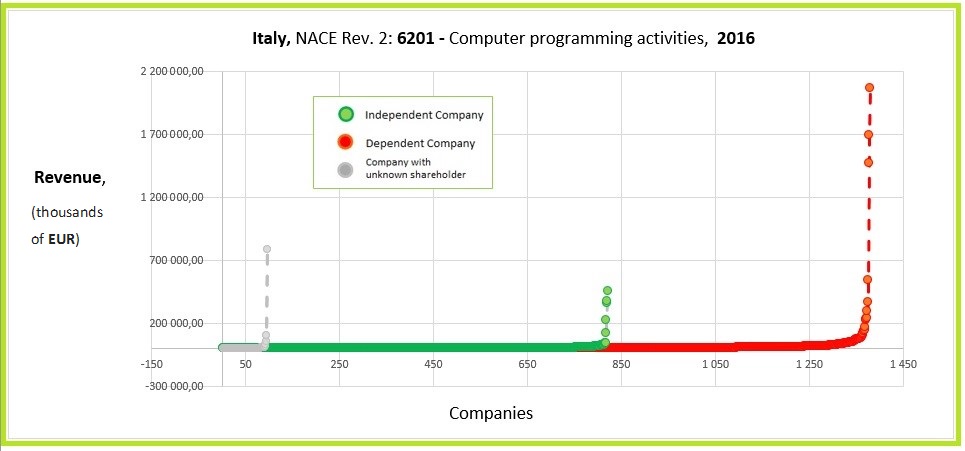
EXHIBIT 7
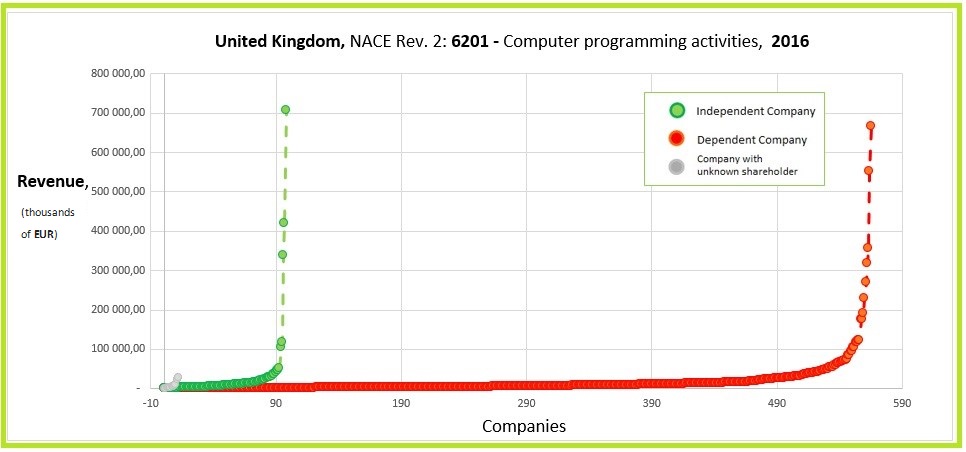
EXHIBIT 8
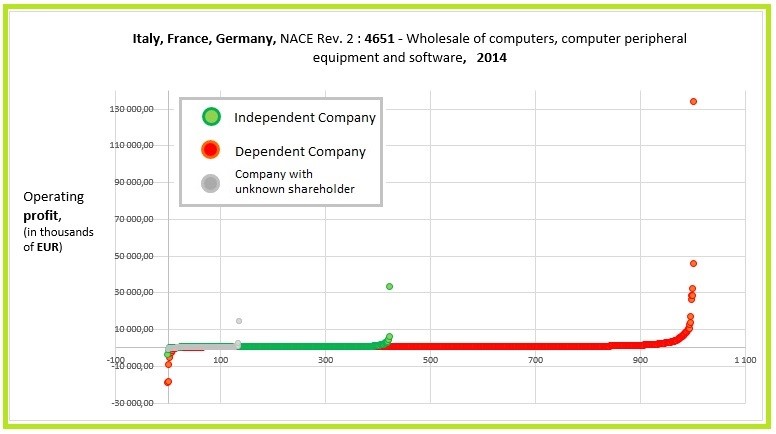
EXHIBIT 9
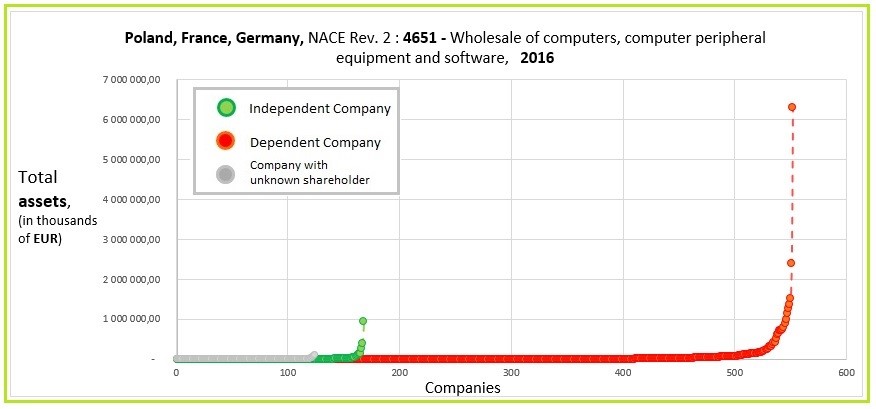
EXHIBIT 10
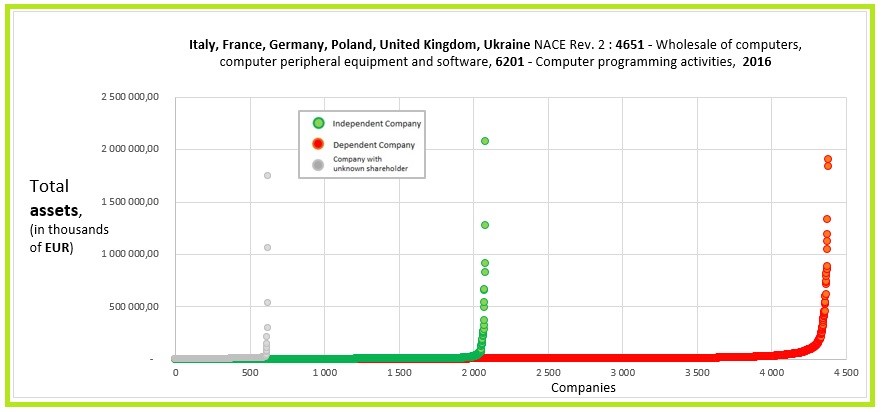
EXHIBIT 11
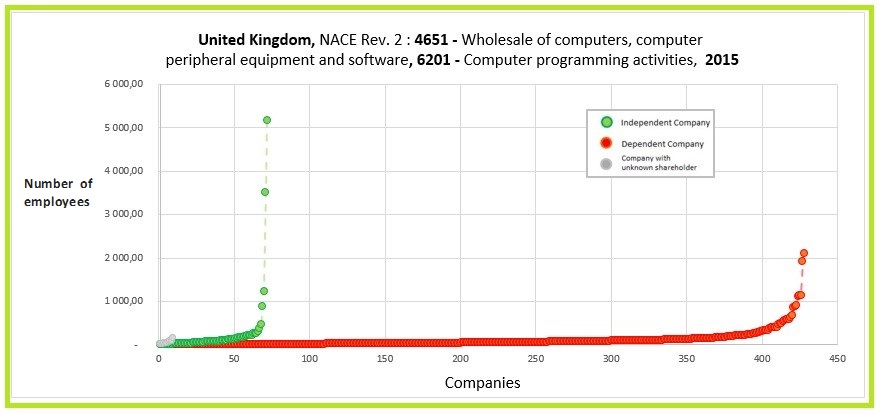
EXHIBIT 12
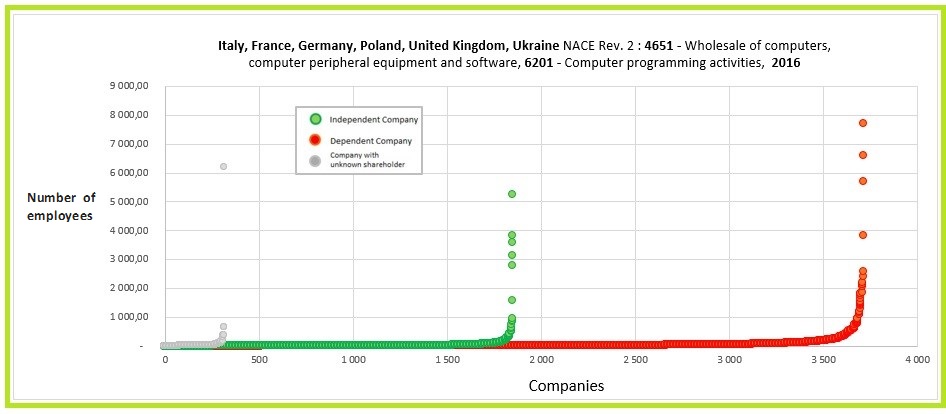
EXHIBIT 13
As you can see,
the indices of “independent” and “dependent” enterprises form the same exponential function у = ах In order to analyze the impact of various quantitative factors, personnel, assets, revenues of enterprises (functions, assets, risks) on the profit and profitability of enterprises, we will consider several examples (statistical (middle, large, very large companies)), without checking the activity on the Internet). Consider the ratio of functions, assets and risks by the example of activity 4651, 6201 in some countries.
Since the exponential function is a function of the inverse logarithmic, it is necessary to consider the relationships of these factors among themselves on logarithmic scales.
EXHIBIT 14
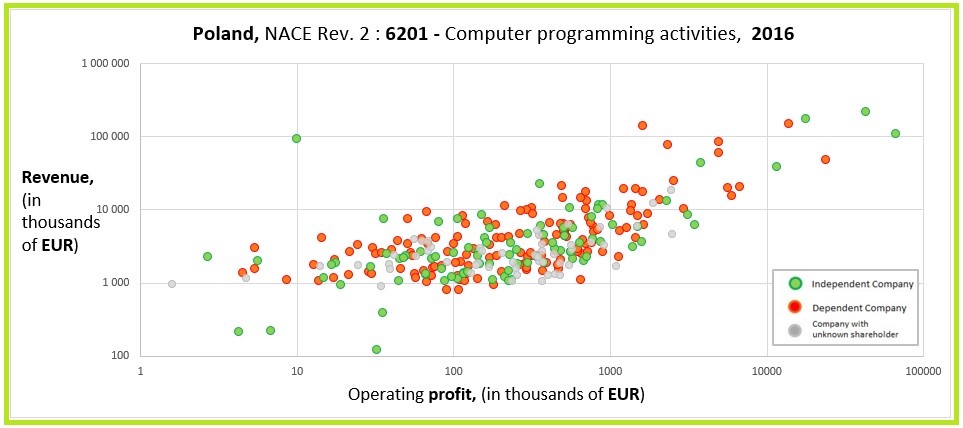
EXHIBIT 15
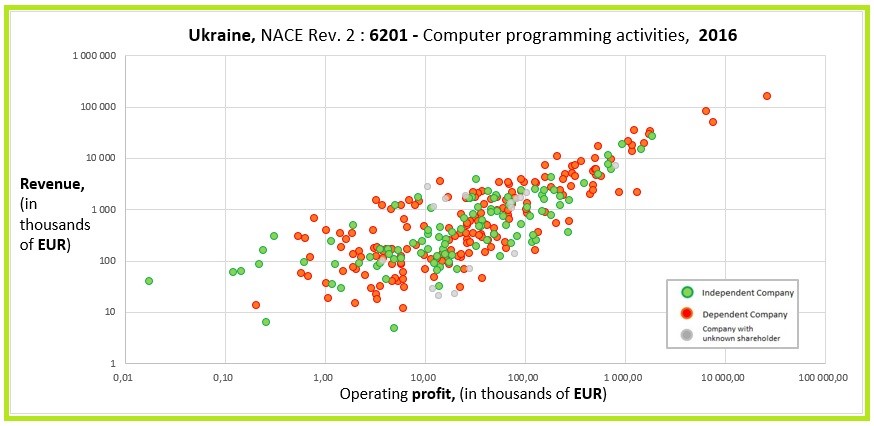
EXHIBIT 16
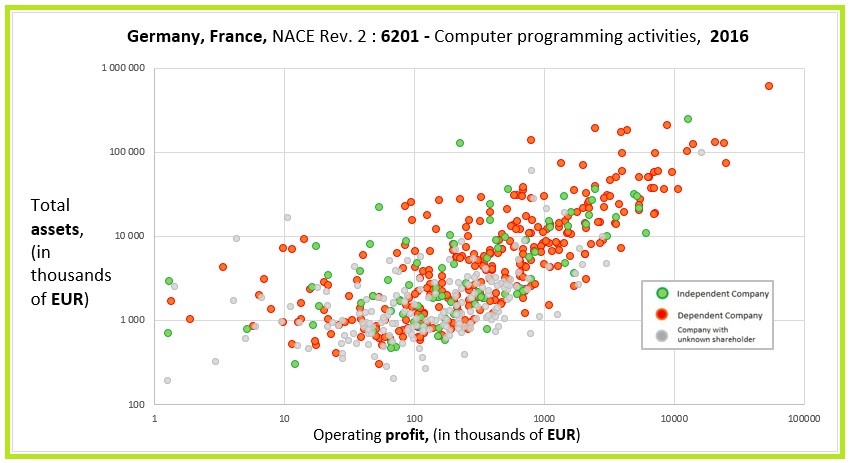
EXHIBIT 17
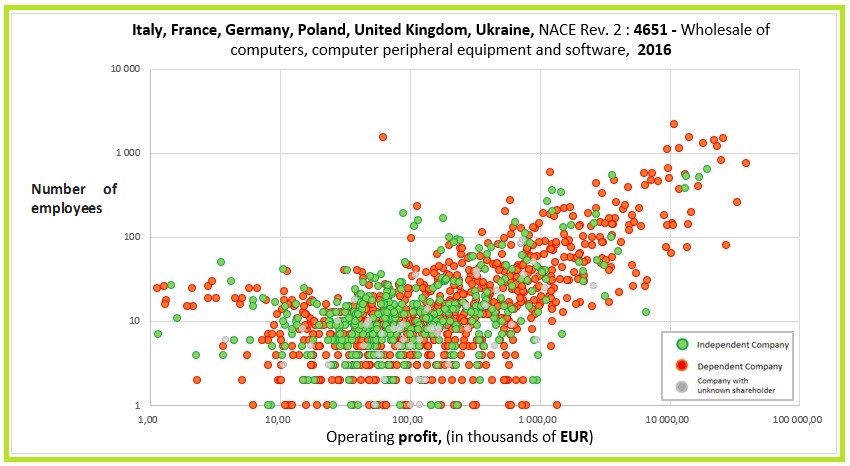
EXHIBIT 18
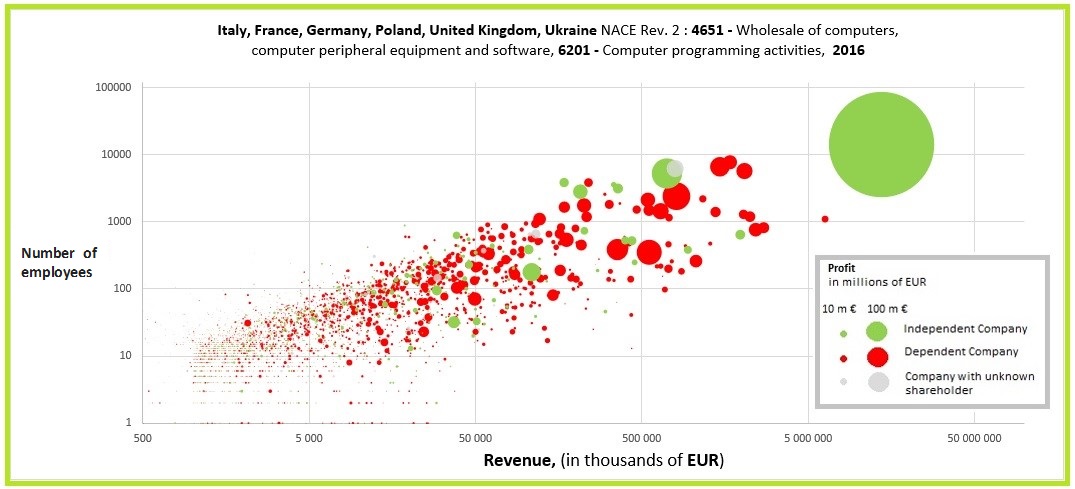
In EXHIBITS 14-18, we see that the company’s profit indicators are linearly dependent on production factors. In fact, these factors are isoquants in relation to each other, with the growth of production factors, profit also grows [15].
Thus, we can conclude that the profit of the enterprise directly depends on such factors of production as personnel, assets, revenues of enterprises (functions, assets, risks).
Another relation for these same companies, in the same period, we see in EXHIBITS 19-25 where profitability indicators are in a chaotic manner with respect to production factors (the beginning and the end of the construction area are narrowed due to the increase in the number of companies with the growth of factors of production and reduction the number of companies that achieved high revenue figures).
EXHIBIT 19
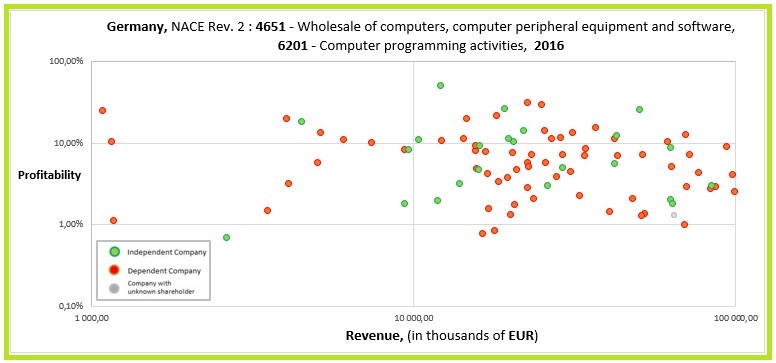
EXHIBIT 20
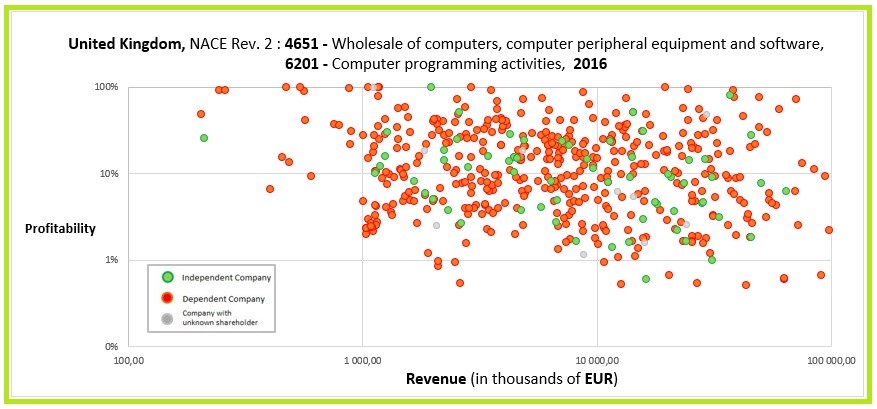
EXHIBIT 21
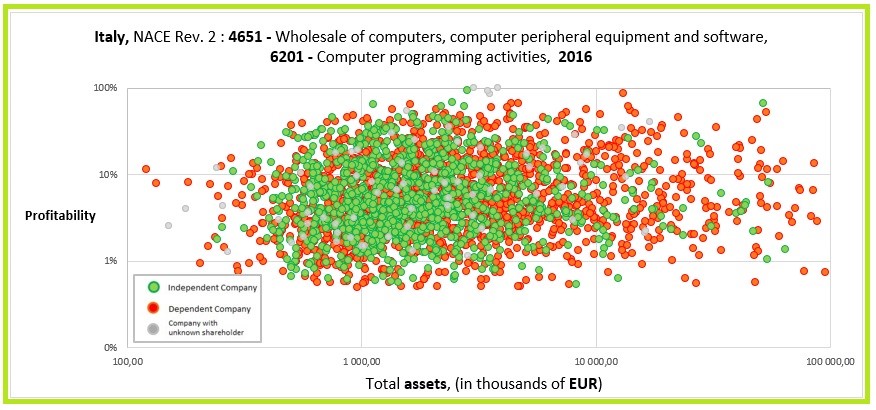
EXHIBIT 22
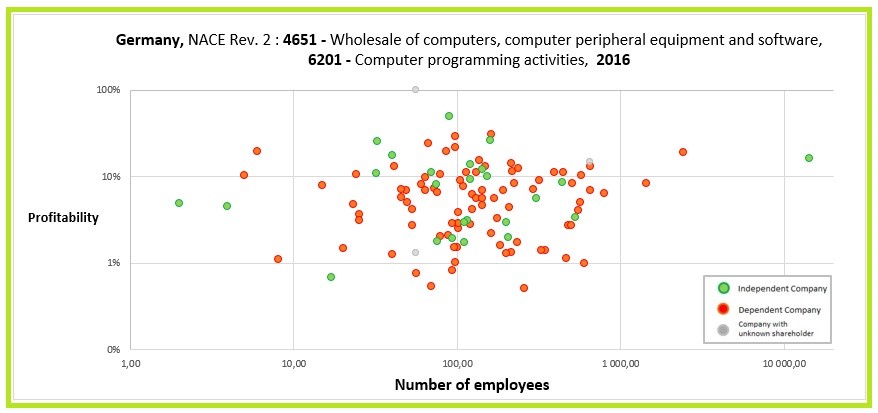
EXHIBIT 23
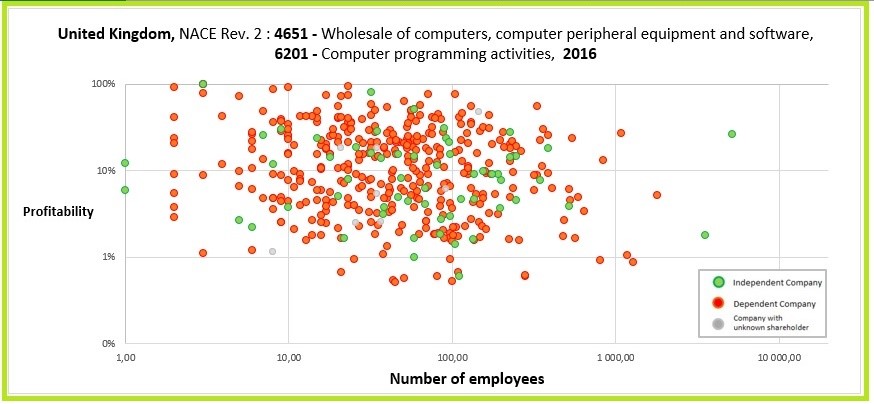
EXHIBIT 24
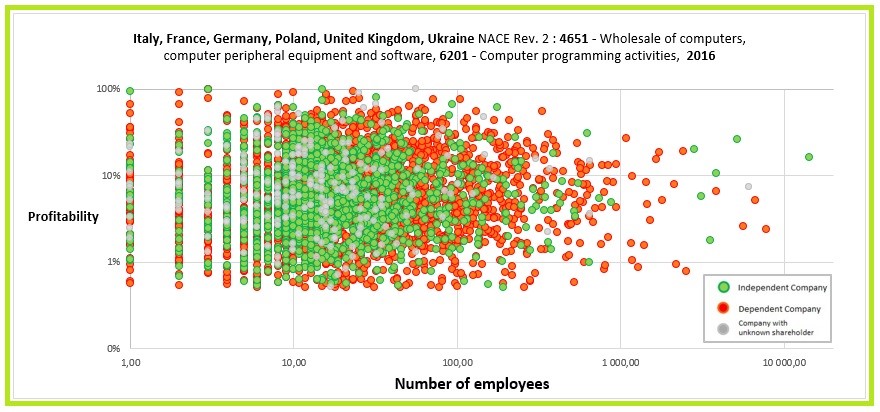
EXHIBIT 25
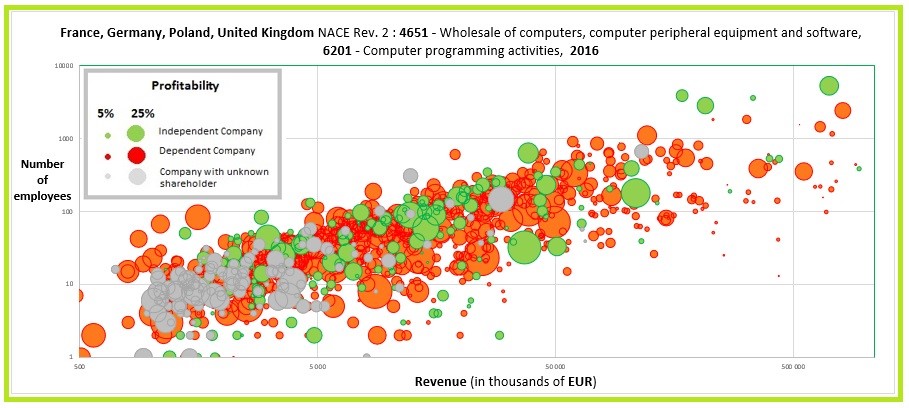
Thus, we can conclude that the profitability of enterprises directly does not depend on such factors of production as personnel, assets, revenues of enterprises (functions, assets, risks)but they can lead to a narrowing of the range of profitability.
This phenomenon can be explained by the fact that if a company achieves (can achieves) certain indicators of profitability and has prospects for growth, the company can attract a loan, increase turnover in order to increase profits. Or, if the profit is provided by the staff, the company can make urgent hiring of additional employees. The profitability indicator may decrease, but a decrease in the profitability index will not be critical, since profitability itself is not the ultimate goal. The purpose of business is not profitability, the goal of business profit.
“Capital … avoids the noise and abuse and is distinguished by a timid nature. It’s true, but it’s not the whole truth. Capital is afraid of a lack of profit or too small profit, as nature is afraid of emptiness. But once there is sufficient profit, the capital becomes bold. Provide 10%, and the capital agrees to any application, at 20% it becomes animated, at 50% it is positively ready to break his head, at 100% he tramples all human laws, at 300% there is no such crime that he would not risk, at least under pain of a gallows. If noise and abuse are profitable, capital will contribute to both “[15].
Other words, no quantitative (extensive, production factor) in itself makes the company more or less profitable and, accordingly, more or less comparable companies in the sample. The income and profit of the enterprise depend on the number of production factors. Exceptions may be quantitative production factors, indicating various quality functions, such as wholesale and retail trade. On the other hand, the quantitative revenue figure of a retail sales company can also be quite high, and here we will still be guided by the verification of activities.
The lack of growth in profitability indicators with an increase in the number of production factors also correlates with the law of diminishing marginal productivity. The law of diminishing marginal productivity has never been proved theoretically, it is always a practical example. Unfortunately, neither in Excel nor in MathCAD is it possible to build a 3D model with three logarithmic axes of ordinates and a fourth spherical diagram to see a possible spatial area of profitability indicators.
Perhaps, after an increase in the number of companies due to a change in the approach to verifying activities, or building a 4D model (X staff, Y assets, Z revenue, S (scope) profitability), profitability indicators form a certain area of ”increasing and decreasing” marginal productivity.
Also, on a graph with a logarithmic scale, we see that with the growth of production factors both the profits of “independent” and the profits of “dependent” companies are growing. Profitability indicators for both “dependent” and “independent” companies are also chaotically distributed on a scale. This corresponds to the fact that many multinational companies set prices and financial indicators in accordance with the requirements for transfer pricing in accordance with the principle of “outstretched hand”. In addition, the transfer pricing policies of many multinational companies include provisions that presuppose the establishment of market conditions and in uncontrolled operations too.
If you abandon a number of quantitative restrictions, limitations on cohesion applied to a sample of comparable companies, or at least reduce their application, and then the number of companies in the final sample for many activities will additionally increase.
But even having significantly increased the number of companies in the sample, the main issue remains open. How to check whether enough companies to ensure that the range was considered “market”, and not part of the “market” range? Above we have already considered that all financial indicators of the company correlate with the exponential function. Uniform distribution on the logarithmic scale of such indicators further confirms that the indicators themselves obey a certain law of “increasing the degree of competitive distribution”, forming values correlating with the exponential function.
It should be noted that mixed samples of financial indicators from different countries, different types of activities, samples with certain limitations (connectedness, income level) also correlate with the exponential function.
Given this circumstance, we can assume that the performance of all companies in a particular market is also subject to this distribution law. This example is a partial induction, and in order for this hypothesis to be accepted or refuted, it is necessary to check the approximated values of all activities, and to increase the quality and reliability of the activity check by the methods indicated in the sections above. If this hypothesis is confirmed, we will understand that the financial performance of the final sample of companies of a certain type of activity in accordance with the principle of full induction should also correlate with the exponential function.
How can this help us? – We can check how many financial indicators of the values found correlate with the exponential function and thus determine how many values are found enough to build a range and what values are missing.
Since, having defined the exponential function as the basic one, we made a certain approximation, then in order to check the sufficiency we need to apply the “least squares method” Least squares (The method ofleast squares) [16].
Assume from the activity X, the year 20XX + 1, the country H, we received 2,800 companies with their financial performance.
Having checked the activity in a traditional way, we found 16 comparable companies.
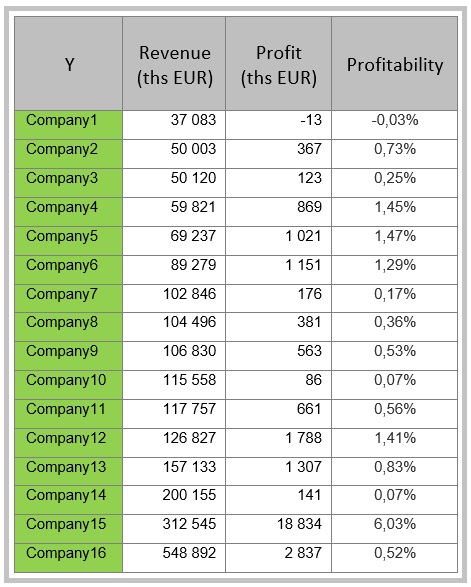
Are the companies found sufficient or there are many others (rejected), and can we find them (calculate their values)?
We apply LSOs (LS) to “search” for an analytical representation of a set of values [17].
To begin with, we will look for the revenue figures of the companies found and for the linear form of the function.
Necessary formula:
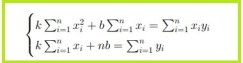
Initially, the general representation for the sixteen revenue values:
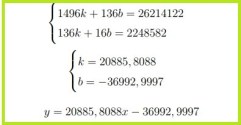
Also in order to evaluate how rational this representation is, consider the approximation error:
The average error of approximation is the average deviation of the calculated values from the actual ones:
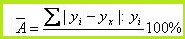
y- the calculated value by the equation.
An approximation error of up to 7% indicates a good selection of the trend equation to the original data.
So we get:
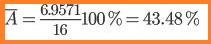
Since the error is greater than 7%, then this equation is not desirable to be used as a trend.
As a result of the above, we break into smaller intervals and estimate the error of approximation.
Gap 1-4:
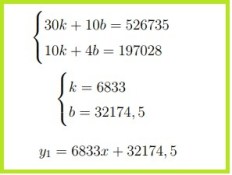
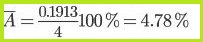
Because the error is less than 7%, then this equation can be used as a trend.
Gap 5-8:
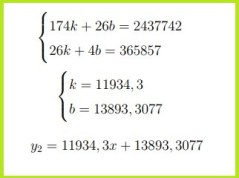

Because the error is less than 7%, then this equation can be used as a trend.
Gap 9-12:
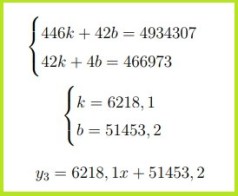

Because the error is less than 7%, then this equation can be used as a trend.
Gap 13-16:
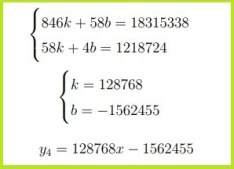

Since the error is greater than 7%, then this equation is not desirable to be used as a trend.
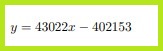
In the interval 13-16 we see that the linear function does not suit us, in this connection we shall break it in even more detail:
Gap 13-14:
Gap 15-16:
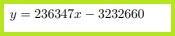
Thus, we see that to select a more suitable linear function, we need to group the values and, in the end, more than two.
If we represent a curve from the same sixteen values through an exponential function, using the same OLS, we get:

Let’s check for the given function the approximation error:
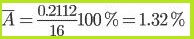
Because the error is less than 7%, then this equation can be used as a trend.
Thus, we see that the revenue figures of companies form a fairly confident trend of an exponential function with an average deviation of 1,32 % and are absolutely not suitable for the trend of a linear function, forming a deviation 43,48 %.
We can assume that the revenue of these companies is sufficient for sampling.
Similarly, we will perform a calculation for the profit indicators of these 16 companies.
Linear function for 16 values
By linear function:
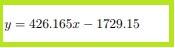
 By exponential function:
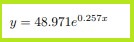

But in this case the error is above the norm, should we take this into account?
Similarly, we will test the trend of profitability indicators.


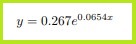

The exponential function gives a smaller deviation than the linear one.
Similarly, you can check and “complete” (without checking the activity “) samples of all activities in all countries and determine the best function for the trend.
Are all trends in an exponential (exponential) function?
The same method can check all the indicators of the final companies – revenue, assets, personnel, profit, profitability and others.
Which indicators of the final companies should correspond to the trend? What percentage of “admissibility” of deviations can be considered the norm and for which indicators?
In order to determine the possible correlation of profitability from other indicators or to prove the absence of correlation, it is necessary to conduct regression analysis using exponential functions of indicators [18] [19].
After increasing the final companies in the sample due to the removal of additional restrictions on revenue, assets and connectivity, additional methods of checking activity, the method of stepwise regression analysis with the method of least squares of exponential functions can be found and other dependencies [20].
These questions are subjects for further research, but in the end, in order to avoid disputes, the results (found or disproved dependencies) will need to be consolidated at the international level in a certain Methodology.
During the calm before the storm it’s time to find a “quiet harbor”
With the increase in the level of international trade, the number of international companies will also increase, the need for TP analyze transactions will be increased to meet the “arm’s length principle”. One option to reduce the administrative burden may be the application of companies “safe haven”. The “safe harbor” assumes that the country publishes in advance a range of profitability that it considers to be marketable. If the payer is within this range, it is considered that his tax deductions correspond to the “extended arm principle”, he should not pay taxes and should not prepare the TP documentation. This is a good saving for everyone. If the payer does not fit into the range, he must either pay taxes or justify the “difference” in his TP documentation.
But, at the moment, such regimes are not a common practice of the TP for a number of reasons, or rather a number of shortcomings of this regime. The disadvantages of creating “safe haven regimes” are listed in the OECD Transfer Pricing Guidelines. Among the main drawbacks is that the “universal range” may be less accurate than the range calculated by all TP rules, and also the fact that ranges built in different countries can lead to double taxation.
And although transfer pricing doesn’t pretend to an exact science, existing principles of limitations of the market range by various quantitative criteria, insufficient information, can lead to sufficiently deep “inaccuracies” in the market range, distorted tax base and tax deductions that do not correspond to real state efforts for business development. An alternative option might be to create a clearer unified Transfer Pricing Methodology based on the existing and accumulated practice of the OECD, Big-4 and large payers. Such a Methodology will not be “simpler” than existing in connection with this; its application will be a big burden for small and medium-sized businesses.
According to forecasts of experts from Oxford and Wales universities, the forecasted year when the computer can read in the ear texts at the human level – 2024 (this year the probability will be 50%), and the compilation of the transcription of oral speech 2023 – 2031 [21]. This means that even in the absence serious “breakthroughs” in the field of automation of translations, by this time people from different countries will be able to communicate in the “online” mode with the help of an already existing application-interpreter and a new audio add-on. Of course, we are not talking about high-quality technical translation, specialized stylistic constructions, but this will be enough to know each other’s needs and opportunities, agree on the basic conditions for interaction. This is what is needed for international trade and what is very lacking in services for the entry of small companies to the international level. This is what small businesses need and sooner or later it will get it.
Increasing the role of small and medium business in international trade by 2024 against the backdrop of the overall growth of the international economy and the number of international companies will create an additional burden on national tax administrations. In such conditions of growth of controlled operations, increasing conflicts between the state and large business in consequence of “conservative counterrevolution,” small and medium-sized transactions falling under the control of transfer pricing risk to receive less “attention” from the tax administrations. Under the attention it is necessary to understand not only the request of the TP documentation, but also the level of competence during its verification, feedback on the results. And we know that no matter what “rigid” requirement exists in the Legislation, implementation should be properly checked.
To ensure that “safe harbors” were more accurate and did not create precedents for disputes, and double taxation, the ranges of the “market” level of profitability:
- Must be calculated for each country (it may be better if, for all states, the calculation is carried out and brought to the OECD as an international organization);
- Must be calculated for all NACE activities (or core in the country), if the activity has subspecies, then the range must be built for each significant subspecies;
- Must include a specific methodology for applying adjustments, if any;
- Can be built on the basis of open information in databases of financial data, as well as information received during the audit of taxpayers (this activity), received in the form of a TP documentation from taxpayers over the past few years;
- If the financial data for constructing a range for one country is not sufficient, the methodology for constructing a range may include the use of indicators of a comparable country, taking into account (adjusting) the “business profitability ratings” of various countries according to the World Bank published in the publication DOING BUSINESS [6].
Of course, the creation and updating of such a catalog of “safe havens” will require a huge amount of work and research costs. But for many years, Big-4 consultants are preparing such studies, and tax administrations archive these packages (requested from payers) with various final samples of such studies. If such data are consolidated and systematized, this will be a good foundation for the creation of both a methodology for research in the field of transfer pricing and a catalog of “safe havens”.
The creation of such Tax methodological standards at the international level will create a methodological basis for the following transfer pricing rubicons, such as the “migration” of chains of creation, consumption of goods and services in the digital era, transactions with settlements in digital currencies using blocking technologies, , virtual “offshorechains”.
Thank you for reading my article.
With respect, AlexeyS !
Many thanks, for the mathematical calculations
and help in the selection of methodology, Svitlana Akopian.
Thank you, for translation, Kateryna Ivanova.
(katrine.zay.ivanova@gmail.com)
If you need any kind of translation, contact her.
Literature and links
- Разработчик из команды машинного перевода «Яндекса» Антон Дворкович: «Грязные данные, вымышленные языки и синтаксические особенности» https://vc.ru/24020-challenges-for-machine-translation
- Brexit Revolution and Counter-Revolution https://www.globalresearch.ca/brexit-revolution-and-counter-revolution/5535210
- BBC: В Латвии ликвидируют банк ABLV, работавший с СНГ https://www.bbc.com/russian/news-43180898
- Rietumu блокирует счета: банк требует информацию о владельцах и офшорах https://ru.sputniknewslv.com/economy/20180321/7734278/Rietumu-trebuet-klientov-informaciju-vladelcah-ofshorah.html
- Bureau van Dijk (is now a Moody’s Analytics Company ) https://www.bvdinfo.com
- Doing Business: The Doing Business project provides objective measures of business regulations and their enforcement across 190 economies and selected cities at the subnational and regional level. http://www.doingbusiness.org
- Хайдукова Д. А. Классификация факторов, влияющих на прибыль предприятия // Молодой ученый. — 2016. — №21. — С. 519-521. — URL https://moluch.ru/archive/125/34745/
- Факторы производства, Материал из Википедии — свободной энциклопедии, https://ru.wikipedia.org
- OECD Transfer Pricing Guidelines for Multinational Enterprises and Tax Administrations 2017 http://www.oecd.org/tax/transfer-pricing/oecd-transfer-pricing-guidelines-for-multinational-enterprises-and-tax-administrations-20769717.htm
- Материал из Википедии: Факторы производства https://ru.wikipedia.org/
- Материал из Википедии: Предельный продукт https://ru.wikipedia.org
- МАРКЕТИНГ: Учебное пособие для подготовки к итоговому междисциплинарному экзамену профессиональной подготовки маркетолога. Под общей ред. В.Е. Ланкина. Таганрог: ТРТУ, 2006. Закон убывающей предельной производительности. Эффект масштаба. Взаимосвязь общего, среднего и предельного продуктов http://www.aup.ru/books/m99/1_10.htm
- Dmitry Kalinichenko (Дмитрий Калиниченко): Закон Грешема – это нелепая ошибка или умышленная подмена понятий и передергивание фактов? Часть II – Закон Рубля https://www.kdggold.com/ru/content/zakon-greshema-eto-nelepaya-oshibka-ili-umyshlennaya-podmena-ponyatij-i-peredergivanie-faktov-chast-ii-zakon-rublya/
- The IFRS Foundation’s: three-tier structure http://www.ifrs.org/about-us/our-structure/
- Economicportal.ru Изокванта (Isoquant), равноколичественнаялиния (isoquantity line) http://www.economicportal.ru/ponyatiya-all/isoquant.html
- Thomas Joseph Dunning (12 January 1799 – 23 December 1873) was an English bookbinder and trade unionist. https://en.wikipedia.org/wiki/Thomas_Dunning
- Ordinary least squares/ Метод наименьших квадратов https://en.wikipedia.org/wiki/Ordinary_least_squares
- Regression analysis https://en.wikipedia.org/wiki/Regression_analysis
- Nonlinear regression https://en.wikipedia.org/wiki/Nonlinear_regression
- Регрессионный анализ https://math.semestr.ru/corel/noncorel.php
- The Economist: Human obsolescence: How quickly will machines sweep man aside? Tim Cross, http://www.theworldin.com/article/14586/edition2018human-obsolescence?navigation=true
- Альтшуллер Г.С., 1973 ТИПОВЫЕ ПРИЕМЫ УСТРАНЕНИЯ ТЕХНИЧЕСКИХ ПРОТИВОРЕЧИЙ https://www.altshuller.ru/triz/technique1.asp

 Oleksii Sorokin Blog
Leave a comment